

Cash Poor, People Rich
Notes on a fraying economy from someone who's great with people and lousy at selling it

I like to joke sometimes that my relationships and network are excellent. If only I could translate that into commercial success.
I’m great at talking to people, listening, being kind and flexing my high emotional intelligence and empathy. I notice details, I proactively check in, I ask questions, I give my full presence and attention when I’m with someone.
I think most people get antsy after too long deep in conversation, without a screen to look into. The intensity of interaction is too much. I’m the opposite. I love diving in with someone—anyone—as long as it’s not mindless chatter or draining, empty calorie conversation.
Conversely, I go blank and I feel awkward when people ask what my business utility is—what problem I solve for people and why I should be compensated for that.
It’s a problem I’ve wrangled with my entire life. Practical skills I’ve learned have been helpful, but I’m always more interested in philosophy. The “why” rather than the “how.” The moral and ethical ramifications more than the tactical steps to grow, sell, and engineer engagement, etc.
This is partly because I strongly believe that overconsumption is killing our planet—that the endless compulsion to accumulate more, to grow more, is actually a terrible spell we’ve collectively fallen for.
Wealth doesn’t impress me anymore.
It’s not that I can’t learn the ways, I just don’t care–or perhaps the connection between self-sacrifice and personal gain hasn’t ever been clear to me. The motivation to persuade and manipulate others isn’t really there anywhere.
Ahead of launching a consulting business, I read both Robert Cialdini’s Influence: The Psychology of Persuasion and Daniel Pink’s To Sell Is Human because I knew that those were skills I’d need to master in order to advance my business. The bottom line to sell oneself: maintain a buoyant attitude, and completely deflect the pain of rejection—because sales is rife with it.
The inner child in me wants none of that of course. It wants to go to bed late, wake up late, have fun every day, and make magic with others in ways that aren’t necessarily commercial. I’m still on the journey of balancing that attitude with the practical necessities of life—of bills, obligations, commitments, and facing imposing, existential challenges.
The enshittification of everything
I made a new friend yesterday and she asked me—how’ve you found being back in Tampa?
The truth is, it’s been a tough reentry. Everything is tough, other than my social life.
Jobs elude me—though as I understand it, they’re elusive in general lately.
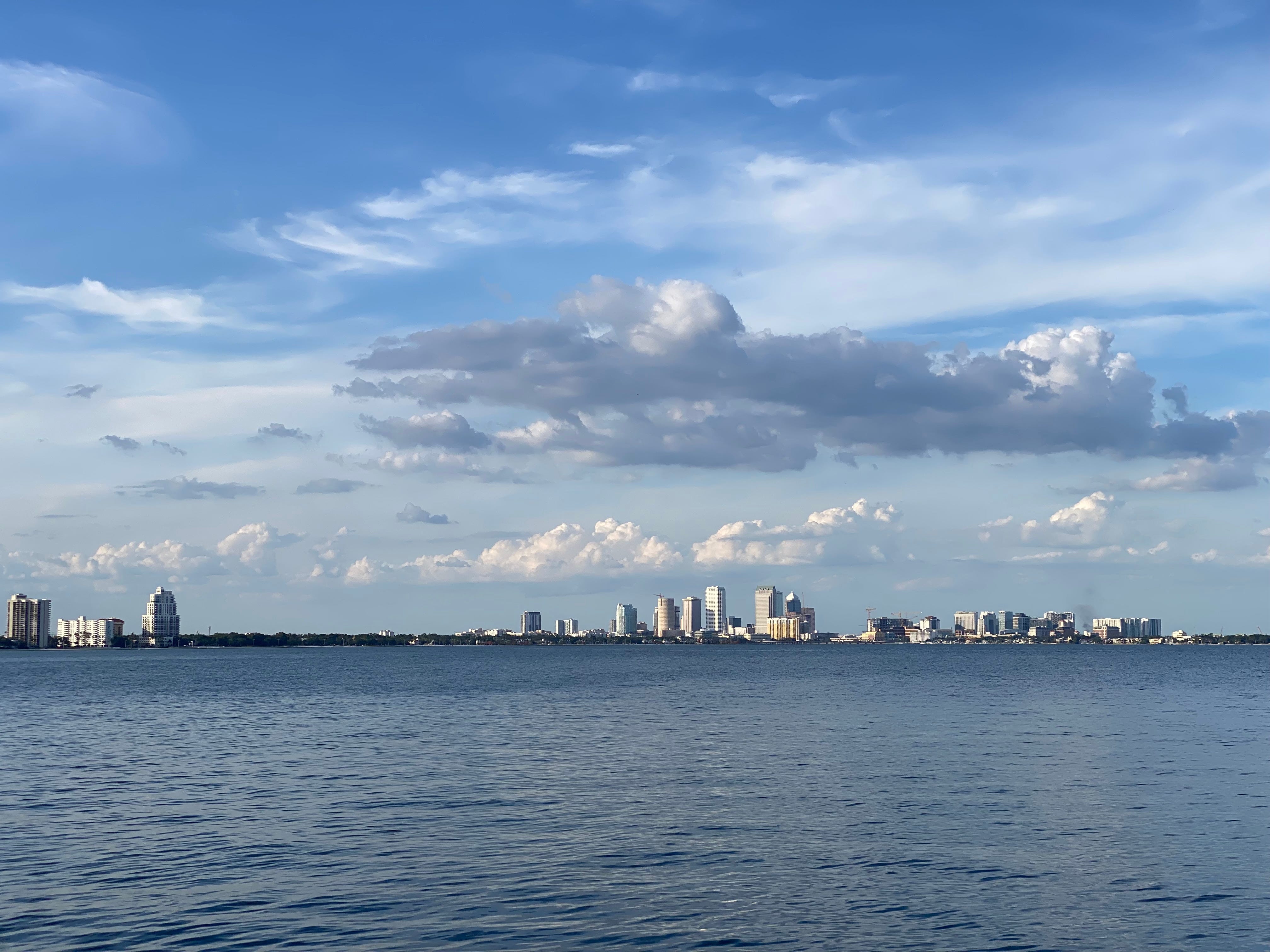
The cost of living is higher than ever before. Tampa is no longer especially affordable, yet it doesn’t deliver the kind of cultural or economic opportunity landscape that larger cities do.
It’s priced itself out of its own best feature: being approachable, affordable, with a good quality of life. Past generations knew this, and they set up home bases here and traveled when they wanted big culture and a faster pace.
I’ve burned through my savings several times over and had to totally rethink my assumptions about who I am and where I want to go with my life and career.
There are days I wake up and feel completely wretched—like prosperity, momentum, ease, and validation will never come. My mind wanders into regret—why’d I leave, not invest here, not ride the wave of progress? How could I be so short-sighted? I left and the place moved on without me—and now I’m behind.
There are other days where I choose to reach for something lighter and more optimistic—days where I start with some yoga or breathwork, listen to Louise Hay affirmations, and lean into what feels true rather than scary.
This present chapter has made me appreciate the present as a respite from the swirling doubt and sensation of mistakes made in the past.
None of us, myself included, deserve to be fighting so hard when there is abundance and prosperity all around. We live in one of the most advanced economies in the world—and yet there’s a growing chasm between those who have more than they need, and those who are squeezed to the margins.
Have you noticed?
Everyone who has a job is slammed—more than they can handle, overwhelmed, low-key nervous about their own job security. Yet the concept of labor sharing—splitting overworked and (frankly) overpaid positions into two and splitting the salary seems to have occurred to no one.
And, most people I know, even those I’ve always associated with plenty of money, feel “cash poor” right now. They’re cutting back and adjusting their spending habits, because they see an economy fraying at the edges and are worried about what might come next.
It’s cringey to see anyone flaunting wealth right now. In the words of a wise friend I caught up with yesterday, “wealth doesn’t impress me anymore.”
I believe capitalism will eventually fail—not because it hasn’t given us incredible things, but because it will always prioritize and maximize capital gain over labor. Labor is viewed as the enemy of capital gain—even though labor is what has built Fortune 500 companies over the years. Human ingenuity. Human sweat.
And when those humans are squeezed from every angle—housing, transportation, healthcare, and food costs—plus an anemic job market, they will revolt. Eventually the distractions and complacencies of entertainment, online gaming and gambling, and promises of both digital and planetary escapism won’t fool people.
I fear that the current administration knows this, and is preparing for a sort of civil war—beefing up ICE recruitment, increasing technological surveillance of dissenters, and preparing for unrest. They’re also lining their own pockets through mass corruption, and have repeatedly floated, and allies have pushed, a third term in defiance of the 22nd Amendment.
They’ve also discouraged broader independent thought by building media monopolies and targeting institutions of critical thought—like my alma mater New College, which underwent a conservative hostile takeover in 2023 and has been turned into a political statement against radical progressivity.
What a tragedy it is that collectively, we’ve allowed ourselves to be tricked by the promise of equitable prosperity and “the shareholders are king” when in reality, our cultural appetite for profit and gains and unfettered greed has completely dismantled the more or less stable democracy we once had.
By the way, many businesses credited with being birthed by exceptional American private venture capitalism were heavily subsidized by the U.S. government. Tesla? Check. Early Silicon Valley startups? Check. The trope of “boot-strapped innovation” is a myth according to economist Mariana Mazzucato.
When I follow the threads and identify root causes, much of it comes back to private equity and the venture capitalization of nearly everything. Every business is expected to grow in perpetuity, to bow to profit pressure, to minimize costs and maximize margins through ultimate “efficiency”—and what we’ve gotten is a bunch of hollowed-out industries and crappy end products that don’t actually have durability over the long term.
The “enshittification” of everything storyline, coined by Cory Doctorow, from social media to food to the auto industry, seems to underline most conversations about the current state of things.
What people really want
No one is asking for a hand out or a monthly welfare check to sit on their butts.
Most people I know just want to live a good life, not to be rich.
They want steady employment doing something interesting, important, meaningful, or challenging. They want the chance to own property, contribute to society, help others when their resources allow, and balance hard work with leisure, hobbies, social time, time off, and ultimately, transcendence.
They want healthcare they can rely on and to not live in a society where they feel constantly like they might step on a financial landmine.
They want durable, reliable products they can buy once and use for a while, rather than things they now know to be designed with obsolescence in mind—the disposability of all things seems to be converging.
What a shame it is that in order to “succeed” these days, we ask that someone be:
Born into wealth; or
Willing to self-sacrifice for the first 30-50 years of their lives (delaying gratification); or
Choose productive paths from early adolescence and essentially never deviate; or
Participate in society’s addiction to competition, otherness, and petty tribalism; or
Invest in the potential for future gain without any guarantees, which opens the door to fraudsters, scammers, and predatory schemers; and/or
Participate in the system that also diminishes their neighbor, in the hopes of quietly, invisibly floating above the average and getting a little bit more to hold onto.
But patterns are emerging that point to a growing disillusion and distrust of the economic status quo. I see little glimmers of awakening—people realizing how lopsided and rigged the system is toward those who already have so much—and resentment toward the sense of inevitability of it all.
These are problems created by humans, after all, and as long as we’re still human beings, we have the power to override them and design better ways of living.
The thinkers who offer real vision past current paradigms
Bernie Sanders is perhaps the most prominent democratic socialist and he’s calling for higher taxes on the richest Americans, just as Elon Musk is set to become the world’s first trillionaire.

Society Explained is a new visualization tool created by ClearerThinking.org and it simply explains and visualizes the logical flows of many of our world’s boldest thinkers, though it also includes viewpoints that are quite different from those of Bernie Sanders.
Jacobin Magazine—founded in 2010 to promote the principles of socialism—has hit a fresh stride thanks to the stunning success of New York City Mayor Zohran Mamdani—a young Muslim candidate who campaigned on the platform of working with and for the people, not the establishment. A year’s subscription to the aesthetically gorgeous, rhetorically rigorous magazine is just $40!
The Wellbeing Economy Alliance is building serious, research-backed alternatives to the extractive model, asking what governance structures and economic metrics would actually prioritize human and ecological flourishing rather than GDP growth.
Another think tank, The Doughnut Economics Action Lab, has developed a framework offering a practical model for meeting every human need within ecological limits.
I’ve written previously about authors Charles Eisenstein and Marjorie Kelly, who turned me on to the idea that alternatives to what we have are possible—if only we see beyond the current paradigm to something that would essentially render 1% wealth accumulation impossible.
How do we tell the story of a new economy? Stories for Life is a tool and reference for how to talk about the interconnected crises caused by a flawed economic system that doesn’t prioritise people and the planet, and to illustrate how a new economic paradigm can help us through the challenges we face. The project’s intent is to shape a more beautiful, viable, life-sustaining world.
The Green Economy Coalition is another entity that exists to accelerate this inclusive and sustainable transition. They work with partners around the world to give citizens a voice, hold governments to account, and drive real economic change. Note that none of their nine global hubs is in North America.
The organization recently released a toolkit: Making the Just Transition Happen: A Futures-Thinking Toolkit for Youth to Use with Their Communities, which covers facilitating change, practicing hope, recognizing structures and systems, and telling new stories about ourselves.
And finally, Alec Leach is a fellow writer and theorist who’s frankly more organized and journalistic about everything he does than I am. His second book is called Someone Should Stop This and it delves into the links between climate change, far-right politics, toxic masculine echo chambers, and our declining quality of life.
It’s now available for preorder ($20).
Whenever I get whipped up into the rhetoric and worry about how things are going here in the “land of the free” I remember there are people who think like I think, and want to design a better future for the human race—not to self promote or pad their egos, but to make life better for everyone they know.
Embracing a generalist world
The truth I have to remind myself of in the midst of mass media gaslighting around economics, work, and value, is: there’s nothing wrong with me.
I’m intelligent, articulate, and I work hard on things that matter. I possess many useful skills, but my resume doesn’t follow a clear or linear arc in any one direction, rather meandering between industries, role types, and skill families.
Up to recently, that may have read as undisciplined, uncommitted, too general. Difficult to place is what I’ve heard. Lately though, there’s a greater movement toward and appreciation for the generalist.
I’m now involved with a global network called Generalist World—which celebrates and encourages career generalists to embrace their “squiggly careers.” It’s an incredibly well-run organization, with free workshops and tools to help generalists navigate the current moment and the transition that’s coming.
They’ve designed an LLM-based chatbot using Lovable that helps generalists reposition themselves based on their work history, skills, and the things that excite them. I used it and loved it.
When viewed through this fresh lens, my career leans more toward soft skills vs. hard ones, and it’s been my opinion, especially lately with the development of more sophisticated AI, that hard skills will largely become the domain of computers and robots—leaving the human to human work to humans.
New Economy Now
Our current moment in time may seem fraught, and in many ways it is. But it is not fatal.
Systems can be redesigned, laws and policies can be adopted, and our benchmarks for success and progress can be repositioned to put humans at the center.
Not profit, or efficiency, but human flourishing alongside the repair and regeneration of the earth—the one and only home we have.
Imagine a society where we offer free education, invest our research efforts in solving real, systemic issues rather than superficial symptom alleviation?
Imagine one where no one is homeless, no one is hungry, and democratic structures allow for diversity of debate, diversity of thought, and no individuals or groups are marginalized?
Where no one is worried about paying bills because housing and food is abundant and everyone is free to pursue their passions and contribute what they want to the world rather than participate in a system that ultimately benefits a small group?
I’m optimistic about a new economy—the work begins now.